
Pricing
What to charge for a move. Hourly or flat, then the number.
Two ways to quote a job, when to use each, how to say the rate out loud, and how the math works. The calculator that turns your crew, your wage and your truck into a price is in the course.
1Pick how you quote
Hourly or flat? Decide before you price.
Both are right. The skill is knowing which one to say on which call. Our rule has not changed in two years: quote flat when the scope is defined and the customer seems like they will have it ready. If either is missing, quote hourly.
Hourly, portal to portal
You tell the customer the rate and a range of hours. The clock starts when the crew leaves your base and stops when it is back, so the drive is paid time.
For you
- You cannot lose money on a job that runs long.
- Nothing to estimate exactly. A range is enough.
- Easy to say. One rate, one range, done.
Against you
- Some customers want a fixed number and will take the quote that gives them one.
- A fast crew earns less on the day.
- Say four to six and take nine, and you have a hard conversation at the door.
Use it when
You have not seen the place. The scope keeps moving. Anything about the customer makes you hesitate. Or you have not done ten jobs like it yet.
Flat rate
One price for a defined job. Estimate the hours, price them at your rate, take the top of the range and round up. The customer gets certainty. You carry the risk.
For you
- Wins more jobs. People like a number that will not move.
- A fast crew keeps the difference.
- No clock to explain.
Against you
- If it runs long, the extra hours come out of your pocket.
- Needs photos, a walkthrough or a real inventory first.
- Needs ten jobs like it behind you to estimate well.
Use it when
The scope is defined and the customer seems like the kind of person who will have it ready when you arrive. Five real jobs, sorted by this rule.
How we say it
The rate and a range, before they ask.
Most customers have never heard "portal to portal." Said plainly, up front, with a total attached, it sounds like every established company, because it is. Here is ours, with our real two-mover rate:
"It's $200 an hour for two movers and the truck, portal to portal, so the clock starts when we leave the shop and stops when we're back. A job like yours usually runs four to six hours, so plan on $800 to $1,200. If it goes faster, you pay less."
That sentence names the model before they can be surprised by it, gives them a total so they are not doing math on the phone, and ends on the part that favors them. Say your numbers, not ours. The whole call, from hello to the deposit, is in the quote script.
How the math works
Cost, then double it, then the hourly rate.
Most people work backwards. They pick an hourly rate that sounds competitive, multiply by the hours, and hope. This is the way a business does it, and it is what the calculator in the course runs on.
Add up what the job costs you
Every hour you pay the crew, including the drive to the counter and home, plus the truck, fuel and supplies. On the example job that is $407.
Double it
$407 of cost becomes an $814 quote. Half of what the customer pays is the job, half is yours. Customers say yes to that when your marketing has done its work before the phone rings.
Turn it into an hourly rate
Divide by every hour the crew is out, base to base. $814 over 5.5 hours is $148 an hour. That is the number you say on the phone, with a range of hours next to it.
Straight answers
Questions people ask.
How much do movers charge per hour?
It depends on the market, the crew size, and whether the truck is included, which is why we will not give you a national number. Call three established companies near you and ask for a quote on a two-bedroom local move. That is your market rate. Then double your cost and see whether it lands above that, below it, or on it. Single items are priced differently, off the minimum: how we do those.
Will customers really pay double my cost?
Yes, when your marketing has done its job before the phone rings: real photos, real reviews, a site that looks like a company and not a guy with a van. Customers do not compare you to your cost, they compare you to the other quotes and to how much they trust you. A 2x quote from a business that looks like a business wins. The same quote from a Craigslist ad with no photos does not.
What does portal to portal mean?
Hourly billing where the clock starts when the crew leaves your base and stops when they return, not when they arrive at the customer's door. It is how established companies bill, and it means the drive is paid time. Tell the customer up front, give them a range, and it is not a problem. Spring it on them at the end and it is. Every term is in the glossary.
What about payroll taxes and workers' comp?
Once you have payroll, they add roughly 10 to 20 percent on top of wages depending on your state. The simplest way to handle it in the math is to put it into the wage: $22 an hour becomes about $26. When you have to set up payroll is in the FAQ.
Why pay myself a wage in the math?
Because one day you will not be on the truck, and if the price only works when your labor is free, the business only works while you are exhausted. Price as if you had to hire someone to do your job. The gap between that and what you take home now is your real profit.
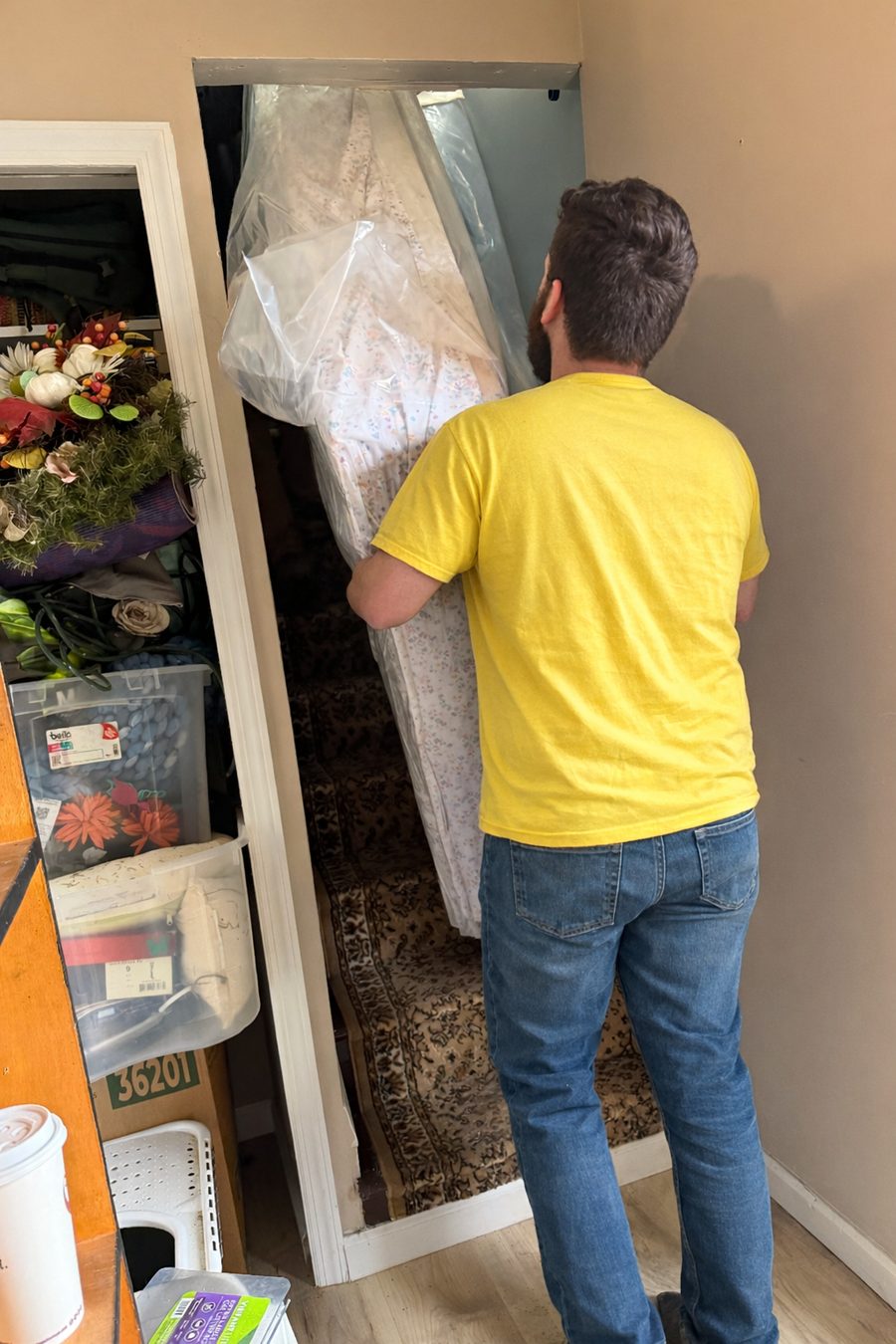
 Blankets and film on every piece. That is in the rate, not an extra line.
 Stairs are an accessorial. Quote them on the call, not on the day.
 A tight wall loads faster and unloads faster. That is the hour you are selling.
2Now the number
Locked
The calculator is in Moving Company in a Month.
The math above is the whole method. The calculator does it with your numbers, in a few seconds, every time the phone rings:
- Movers, hours, wage, truck and markup in; an hourly rate, a minimum and a flat quote for the same job out
- Every line of the quote: wages, drive time, truck, supplies, and what you keep
- The same job with two, three and four movers
- What a long day does to a flat quote and to an hourly one
- The prompt that gets you a range of hours before you have a job log of your own
- Three rules we learned the expensive way
All course sales are final, so every module is listed on the course page before you buy.
Still have questions about pricing?
Bring them to us. The page gives you the method and the course gives you the calculator. The call gives you what your market actually pays, when you can push past double, when to let a job go, and an answer to whatever you are stuck on, from two people who priced it wrong for two years and then got it right.