
Marketing
Why a customer pays you double and says no to the cheaper guy.
The calculator tells you to quote twice your cost. This page is why that works. Customers do not compare your price to your cost. They compare it to how much they trust you before you ever pick up the phone. Everything below is what builds that trust, shown with our own company.

The teardown
Two listings. Same town. Same truck.
Here is what a customer sees when they search for a mover. One of these gets the call at a higher price. The other gets the call when the first one is booked.
What most beginners post
MOVING HELP CHEAP RATES!!! 2 guys and truck
Fast reliable movers, best prices in town, call or text anytime, cash only, no job too small!!!
555-0134
- No photos. The customer cannot see a truck, a person, or a single wrapped piece of furniture. They fill in the blank with the worst mover they have heard of.
- No name. "2 guys" is not a company. There is nobody to look up, nobody to review, nobody to hold responsible.
- Leads with cheap. The only claim is the price, so the price is the only thing that can be judged. This listing has volunteered to be the cheapest, and it will be.
- Cash only, no agreement. Reads as "no insurance, no recourse." The customer with the nice furniture just left.
What we post

Hercules Moving Heroes
Uniformed crews, every piece wrapped, a signed agreement before the truck rolls. Upfront pricing, portal to portal, no surprises at the door.
Get a quote →
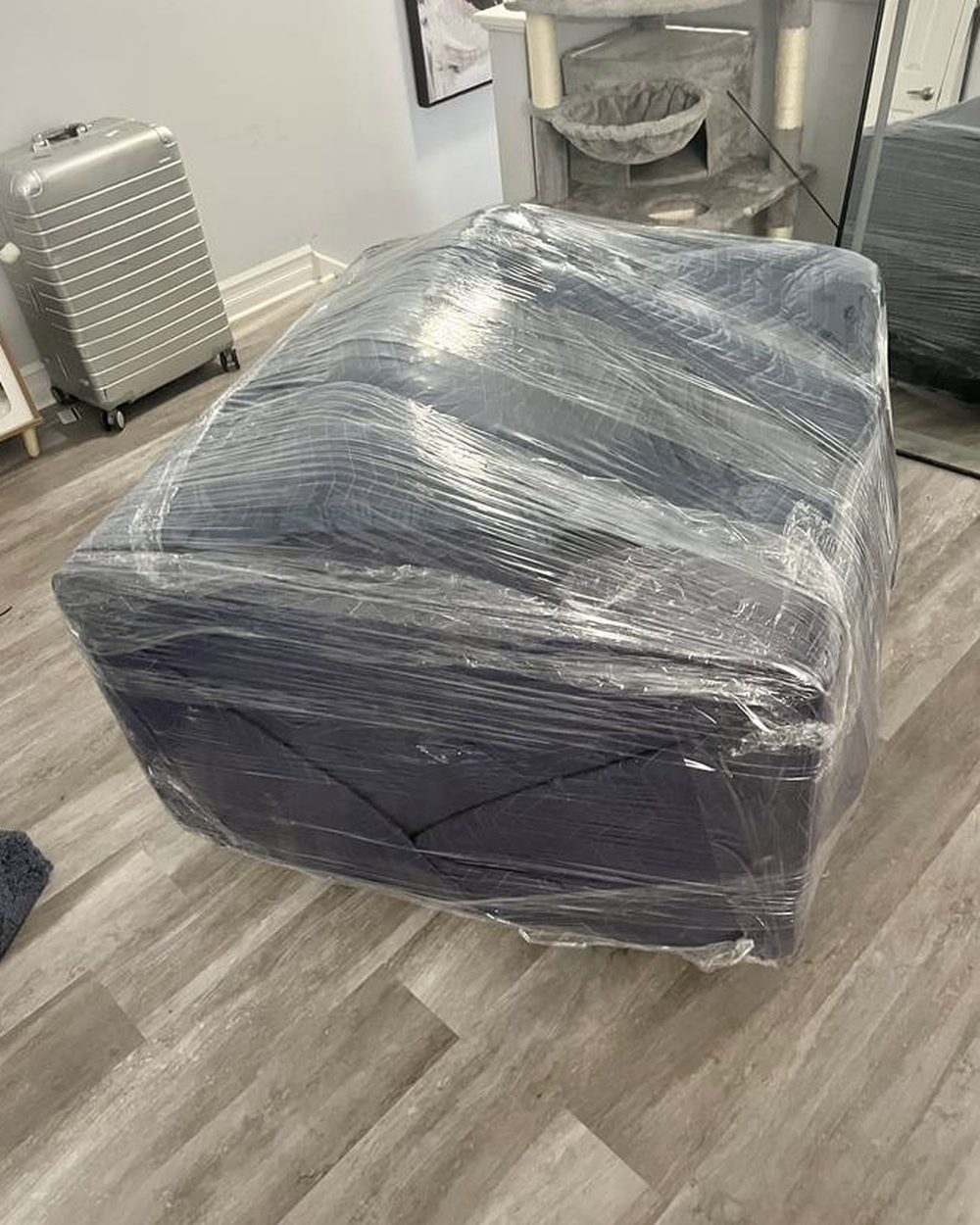
- Real photos of real jobs. A crew in matching shirts standing in front of furniture they wrapped. Nothing staged, nothing stock. The customer can picture these people in their house.
- A name and a face. A company name, two owners with real names on the about page, a logo that shows up on the shirts, the truck and the agreement.
- Leads with trust, not price. Reviews, wrapping, a signed agreement. By the time price comes up the customer has already decided they want these people, and the number just has to be reasonable.
- A process. Agreement, deposit, arrival window, portal to portal. Process reads as "they have done this a thousand times," which is worth more than any single photo.
The first listing is a composite. Nobody in particular, everybody in general. We wrote worse than it when we started.
What ours looks like
The four things a customer actually sees.
None of this is expensive. All of it is deliberate.


Reviews
The asset that compounds.
Our Google profile is rated five stars, and it is where most of our work comes from. Not because we begged for reviews. Because we ask the same way every time, at the same moment, and the moment is the whole trick. The words are in the quote-call opening.
Ask at the truck, not by email
The customer is standing in their new place, everything arrived, the crew was polite. That is the peak. An email two days later lands after the feeling has faded.
Make it a ten-second task
A link they can tap on their phone, right then. If they have to find you on Google later, half of them never do.
Respond to every one
The next customer reads your replies more carefully than the reviews. A calm answer to the one bad review does more than ten good ones.
The website
What a moving site has to do in five seconds.
- Say what you do and where. "Movers in [your area]" in the first line, not a slogan.
- Show a real photo above the fold. Your crew, your truck, a wrapped piece. Not a stock family with boxes.
- Put the phone number where a thumb lands. Most of your visitors are on a phone, in a hurry, with a move date.
- Show the reviews. Pull the Google rating onto the page. It is the only thing on the site the customer fully believes.
- One way to get a quote. A form or a text button. Not five.
Our first site was a template. It worked because it did the five things above, not because it was pretty. We are now moving it to a site we control, built the same way as this one, and that build is part of what we will show you.
One month, no theory
What $82,000 in a month actually looks like.
August 2026, straight off our job calendar. Our best month so far, and on its own a pace of nearly a million a year against the $750K we quote for 2026. Neither of us carried a box. This is what the marketing above turns into when it works.
- About $1,600 a job, $2,900 a working day. The range was a single couch across town on one end and a two-day, $5,000 delivery to New Hampshire on the other. Most jobs were neither.
- Six long-distance runs. Brooklyn twice, the Bronx, New Jersey, New Hampshire, and a truck loaded for Toronto. The rest were local, which is where the reliable money is.
- Eight labor-only jobs and three packing days. Loading a customer's pod or U-Haul is the easiest work to price and the fastest to fill a gap with. Say yes to it.
- Seventeen of the 52 were on a weekend. The customer picks the day. Your calendar is not a nine-to-five.
- Crews of two on most jobs, up to five on one. Earliest truck out at 6:15 AM, latest back at 8:15 PM, and three days in the whole month with nothing booked.
Revenue is gross, before expenses. Job counts are calendar entries; a few jobs ran two days and appear twice. This is our month, in our market, three years in. It is not a promise of yours.
Why it lets you charge double
Trust is the discount.
The cheap quote is not cheap
A customer choosing between a $600 quote from a listing with no photos and a $900 quote from a company with wrapped couches and five-star reviews is not deciding whether to save $300. They are deciding whether to risk their furniture, their move date, and their afternoon on a stranger. Most people with anything worth moving will pay the $300 to not find out.
You cannot argue them into it on the phone
By the time someone calls, they have already decided how much they trust you. The photos, the reviews, the website did that before the phone rang. The call just confirms it. That is why we say marketing does its job before the quote, and why the same $900 number wins from one company and loses from another.
It is cheaper than you think
Shirts, a logo, a phone with a decent camera, twenty minutes a week posting real jobs, and asking for the review at the truck. That is the whole program for the first year, and the first job page has the three photos to start with. The expensive part is the discipline to do it on every single job, which is what we teach.
This is the part we teach.
The photos, the reviews, the site, the ask at the truck, in the order to do them and with what we would skip. It is Module 9 and Module 11 of Moving Company in a Month, opening November 3. If you would rather have it in an hour on your own market, book the call.